
I was born on the East Coast of America to loving parents on Saturday, September 8, 1945, at 11:45 in the morning in Morton Hospital, located on Lakeview Avenue in the seaside hamlet of Taunton, Massachusetts, flanking nearby Cape Cod.
My father, who was serving in the United States Armed Forces, was awaiting transfer overseas during the final months of World War II. My mother and older brother joined him in anticipation of my birth.
I was born a classic baby boomer and wartime baby and grew up enjoying an idyllic and blissful upbringing with little or no conflict, hardship, or need. As I emerged from childhood, I embodied many of the customary stereotypes associated with this cohort.
After my father’s wartime obligations ended, our family returned to my parents’ birth state of Utah, where they raised their family for several years. During our time in Utah, my father utilized the GI Bill to support our burgeoning brood and chose to reenlist in the Army. He enrolled in a program that allowed him to qualify as a soldier with a rank based on his prior experience as a senior non-commissioned officer.
After commissioning as a Second Lieutenant in the United States Army, my father was chosen to serve as an interpreter overseas and was assigned to language school in Monterey, California.
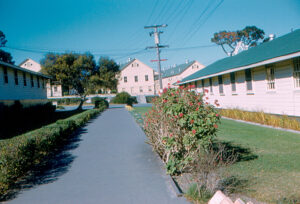 My mother, my siblings, and I moved to Seaside, California, located on the Monterey Bay, overlooking the Pacific Ocean.
That moment marked my initial encounter with theocean’ss majesty, grandeur, and power, awakening a lasting relationship and love affair for the sea, whose allure and spectacular imagery have endured with me ever since.
The East Coast is known for its conservative and traditional appearance, which drew me to fantasies, the presumed elegance, and sophistication reminiscent of F. Scott Fitzgerald’s “The Great Gatsby” and the preppy vibe of ivy-covered college campuses.
In contrast, the West Coast of California is characterized by its laid-back coastal atmosphere, casual dress, longer hairstyles, and a surfing society of art, music, and literature.
This divergence between the two cultures is genuine and exists in real time between the two coastlines of the nation.
This contrast shaped my early childhood development.
Although I was born on the East Coast, my earliest character traits and mental aptitudes were linked to Southern California.
In fact, most of my childhood memories are from California rather than Massachusetts.
Some of my earliest memories from those days were visiting Fisherman’s Wharf on the bay.
I remember riding, perched on my father’s handlebars, feeling the cool ocean breeze against my face. The salty scent of the sea mingles with the aroma of freshly caught fish in the air. The wharf was alive with activity—fishermen unloading their catch, tourists snapping photos, and children laughing as they chased seagulls. 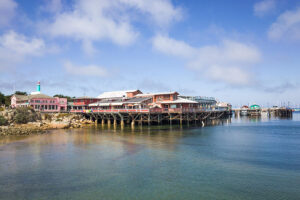
As we approached the shore, the sound of waves crashing against the wooden pillars of the waterfront grew louder. My father pointed out the various boats, each with its own story and purpose. There were small fishing boats, elegant sailboats, and even a few large ships docked further out.
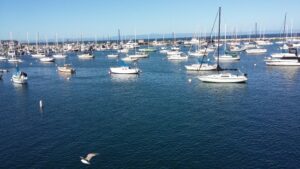 We often stopped at a small seafood stand where my father bought us clam chowder served in sourdough bowls. We would find a bench overlooking the water and savor our meal. The chowder was homemade, always fresh, and exquisite; the views were captivating as the sun began to set, casting a golden glow over the wharf and the ocean beyond.
As we refinished our meal, my father shared his own stories and experiences of the ocean.
He could describe the beauty and majesty he encountered, as well as the valuable lessons he had learned from the sea.
That magical place and time were filled with memories and possibilities, leaving a lasting impression on me.
Those days at Monterey Wharf became cherished moments, serving as a reminder of the simple joys of life and the special bond between my dad and me.
The central coastal region of Southern California has always held a special place in my and my family’s hearts, and the return to its beaches and shores was captivating in many ways.
My mother’s cousin was the Administrator-Caretaker of Will Rogers State Park, nestled in the Santa Monica Mountains, and we returned often in the summer months, where he taught me to surf.
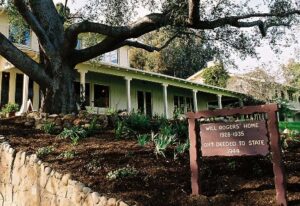 My mom’s relative lived in the grand and stately mansion of the old cowboy philosopher, while we stayed in one of the guest cottages on the grounds. 
California, with its sunlit coastlines and storied landscapes, seemed to have woven itself into the narrative threads of my family’s life.
Each visit to Will Rogers State Park and Southern California became more than just a summer’s interlude; it developed into a journey back to the legacy of old Hollywood, horseback trails winding through eucalyptus groves, and evenings spent listening to tales of yesteryears that echoed with laughter from decades passed.
There was a gentle magic in waking up to the scent of citrus groves and salt air, the hillsides streaked with early morning light.
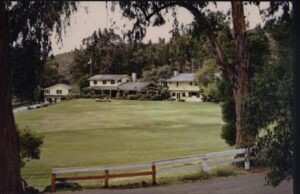 I remember the excitement before theday’ss adventures, watching the mist lift off the mountains, listening to the distant crash of waves, and feeling the anticipation of exploring the trails where generations had wandered before me, swimming in the ocean, surfing on the vast, golden beaches of Pacific Palisades became daily rituals of clumsy grace, of each ride on breaking waves, a new lesson in balance and courage and the unbridled joy of coexisting with the sea.
I learned of the breaking news and events surrounding the tragedy that affected the Palisades and Will Rogers State Park from broadcast reports on television.
The images appalled me with shock and horror as the pictures captured the devastating fires that swept through the mountains, foothills, and coastal towns.
Driven by the Santa Monica winds, the blaze raced uncontrollably throughout the park and surrounding communities, causing catastrophic damage.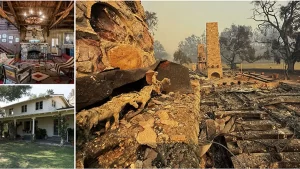
The inferno destroyed much of the open space, botanical gardens, and surrounding parklands while incinerating the iconic mansion to the ground, leaving behind a trail of destruction, ashes, and debris in its wake.
The images sickened me as the haunting words from Don McLean’s classic anthem American Pie came to mind: “Fire is the devil’s only friend.”
Even after flames from fire tore through the park, transforming the familiar landscape with its raw force, there was an unspoken promise among the community—a resolve to heal and rebuild, to honor history by refusing to let it fade.
The area retains its importance, as shown by shared stories and the restoration work in gardens, grounds, woodlands, and infrastructure.
Visitors and tourists have returned to the beloved Santa Monica Mountains, beaches, and shores for relaxation, inspiration, and memories of bygone eras that overlap and coexist with the realities of an altered, heated, volatile world that cast its darkness, wreckage, and devastation upon the venerated estate of Will Rogers and the Santa Monica slopes and foothills.
Probing the damage done to the area while interlocking the recollections of past celebrations, the enjoyment of happier times still linger in my psyche, and somewhat lessens the pain and loss of my beguiling park and childhood playground, which meant so much to me in my youth and brought comfort to my soul during those carefree, summer days frolicking on the shores and beaches of the Pacific Ocean.
There is still much more to share about my California story and its history.
I will cover the key points.
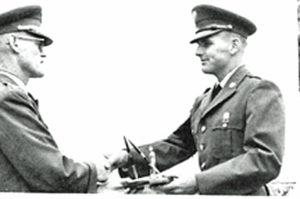 I attended Basic Training in the United States Army while stationed at Fort Ord, California, in Seaside, on the Monterey Peninsula abutting the Pacific Coast shoreline.
I spent my Honeymoon at Pebble Beach Resort, visiting and playing golf on the storied Links.
I attended and broadcast six United States Open Championships for the Rocky Mountain Golf Radio Network, contested at Pebble Beach Golf Club in 1972, 1982, 1992, 2000, 2010, and 2019.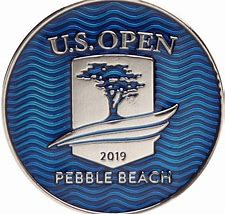
Our initial family vacation following my marriage and the birth of our children was to Southern California, where we toured Disneyland, Sea World, and traveled along the Pacific Coast Highway to visit its various coastal villages, shops, and attractions.
During our visit to Monterey, California, I identified the residence associated with my early years, the military facility where I completed basic training, and the language institute attended by my father forty-five years prior, when I was just a boy.
Although I have spent most of my life in Utah, I still relate to California’s easygoing lifestyle and vibe.
However, the crown jewel of my involvement with Southern California was through my daughter, Sarah.
She began her collegiate experience at the University of Utah while working for the Utah Grizzlies of the Eastern Hockey League.
Sarah amplified her marketing experience by volunteering for the Goodwill Games in New York City and the 2000 Summer Olympics in Sidney, Australia.
Accepting a position as assistant to the Marketing Director for the Long Beach Ice Dogs competing in the West Coast Hockey League, she moved to Long Beach, California, while continuing her education at Golden Gate College.
Sarah progressed to Special Affairs Coordinator for the Los Angeles Clippers of the National Basketball Association before accepting the Marketing Director position at Pebble Beach Corporation and moving to Pebble Beach, just off a seventeen-mile drive in Monterey, where I was in heaven when we visited.
I was truly blessed to have the opportunity to visit Sarah and a region that holds significant meaning for me.
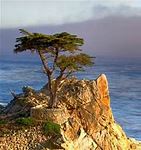
During my visits, I played every course on the peninsula except Cypress Point Golf Club, which is known as the world’s most eminent private and exclusive golf facility anywhere on the planet.
 One day, during a visit, I happened to call the course and asked for the Director of Golf.
I explained who I was and asked about playing privileges typically extended to PGA Professionals.
He very graciously explained that the club allowed one foursome of PGA Professionals a week outside playing opportunities on Monday afternoons.
Those positions were filled for the current week, but there was one spot for the following Monday if I was available, which, unfortunately, I was not, as I was going home in a few days.
He gave me his name and phone number and told me to call the next time I was in town.
I thanked him and said I would.
Two months later, Sarah accepted a marketing position with the New Orleans Hornets of the NBA and left California, never to return, along with any chance I had to play the greatest private Golf Course west of the Mississippi River. I never had another opportunity to play the West Coast’s top-rated and most expensive private golf club in the United States.
However, I have played all the other courses on the Monterey Peninsula, and they are all outstanding in every way.
Pebble Beach is still my favorite golf course of all time; the setting and challenge of its property and the surrounding Monterey Bay in Pacific Grove, California, have been called the most spectacular and beautiful oceanside golf links in the world.
Many people have called the location the most dramatic marriage of land and sea to be found anywhere on earth.
Pebble Beach has hosted multiple Major Golf Championships in its history, and by whatever criteria you use, it is ranked as one of the supreme golf properties in existence.
Augusta National in Augusta, Georgia, Pine Valley in Clementon, New Jersey, The Old Course at Saint Andrews in Scotland, and Pebble Beach in Pacific Grove, Southern California, are the only golf courses to have been ranked No. 1 in the world at any time, and rightly so.
I concur with that assessment, except for Pine Valley, which I have not visited or played.
Southern California, with its scenic ocean views, mild climate, and inviting atmosphere, has consistently offered an exceptional environment for living, personal development, and travel.
Having been born on the East Coast, raised on the West Coast, and spent my formative years in the Mountains of Utah, I have gained some measure of insight into the distinct advantages present across various regions of the country and the oceans that bookend our shores.
I am fortunate to have traveled and gained valuable insights from those opportunities.
My awareness of the sea began with my first encounter, standing at the end of the Monterey Pier, where I first observed the ocean’s immense power, force, and energy.
My enduring respect and appreciation for the sea’s unparalleled authority persists to this moment, while extending that reverence to other bodies of water around the globe as well. 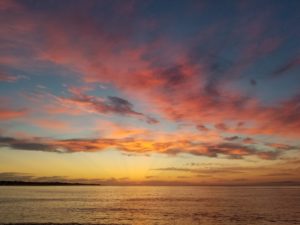
I have been fortunate to have journeyed the world as a Golf Professional and Broadcast Journalist and have dipped my toes, to speak metaphorically, in every deep-water puddle on earth except for the Indian Ocean.
Including the Atlantic Ocean, Pacific Ocean, Arctic Ocean, the Sea of Japan (East Sea), Mediterranean Sea, Caribbean Sea, Gulf Of Mexico, and The North Sea.
Throughout my travels, I have made it a priority to visit and engage with the various bodies of water, lakes, oceans, seas, and streams, to observe and appreciate their unique features and natural characteristics.
By sailing, cruising, swimming, and exploring these environments, I have gained valuable insights into the distinctive wonders they present and developed a deeper understanding of their environmental significance.
Without it, civilization would perish from the earth.
My Love of the sea began as a young boy grazing off the dock of Fisherman’s Wharf in Monterey, California.
The image of that memory remains indelibly etched in my memory alongside my recollections of childhood frolicking on the shores, blended with the music, harmony, and the fragrance of the waves.
My Love of the sea began as a young boy standing on the dock of Fisherman’s Coast of Monterey, California.
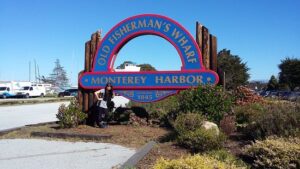 A copy of that view remains indelibly etched in my memory, alongside the recollections of my childhood cavorting on its shores, blended with the music, harmony, and fragrance of the sea.